Twenty Questions
When I was young, my grandfather worked hard to peel me away from the GameBoy I brought to his house. He wanted to teach me the ways he liked to play.
We did riddles. We played chess. And eventually, he taught me Twenty Questions.
The trick, he explained, was never asking more questions. It was asking better ones. The best questions don't gather information; they eliminate possibilities.
When Mark Davis first brought me his idea for a "control plane" for agentic travel, I thought about that game immediately. And the more I sat with it, the more I realized it named exactly what's broken in how AI has been applied to travel so far.
Everything in this post is a learning, not a theory. Over the past year we've operated Voyagier as a working travel agency, with $1MM+ in bookings with Voyagier as the merchant of record, and we've spent that year watching real advisors guide real travelers from a vague idea to a booked trip. What we built is the formalization of what we saw them do — and it all comes back to that game in my grandfather's living room.
Travel's real problem isn't search
Twenty Questions dates back to at least the 1780s. What began as a parlor game later became a radio phenomenon, and a foundation of information theory.
If each question halves the remaining possibilities, twenty questions can identify one answer from over a million options. As philosopher and logician Charles Sanders Peirce observed in 1901, his framing has never been beaten:
"Twenty skillful hypotheses will ascertain what two hundred thousand stupid ones might fail to do. The secret of the business lies in the caution which breaks a hypothesis up into its smallest logical components, and only risks one of them at a time."
The reason this matters for travel is simple. Most AI travel products start with a chat box. A traveler describes what they want, an AI asks questions, runs search, and eventually produces recommendations. The experience can feel intelligent, but underneath, most systems are simply reacting to conversation.
Most AI travel products are remarkably good at conversation and surprisingly bad at memory. They ask, they search, they respond, but they don't hold a structured picture of the trip taking shape. That's not a model problem. It's a missing layer, and it's the layer we set out to build.
This isn't a problem with the AI models. The models are extraordinary. It's an architecture problem, and solving it is why we built Voyagier Blueprint.
Travel planning isn't a search problem, it's a decision making problem
In the 1970s, mathematician Stanislaw Ulam reimagined Twenty Questions with a twist: some answers may be wrong. Success depends not just on asking good questions, but on navigating uncertainty, retesting assumptions and updating conclusions as new evidence emerges.
It's also exactly the problem agentic travel planning is trying to solve in the real world. Every trip contains hundreds of interconnected decisions: destination, dates, flights, hotels, room types, activities, budgets, loyalty programs, traveler needs, and countless other constraints. The challenge isn't finding answers. It's determining which questions matter most and when to ask them.
The best travel advisors understand this instinctively. They rarely start with "where do you want to go?" Instead, they ask questions that reveal the shape of a trip:
Is this a celebration or an escape?
Do you want everything planned, or room for discovery?
If we get one thing exactly right, what matters most?
A few thoughtful questions can reveal more than dozens of transactional ones. For years that expertise lived inside individual advisors. We built Voyagier Blueprint to turn that expertise into infrastructure.
Introducing Voyagier Blueprint: the travel control plane for the agentic era
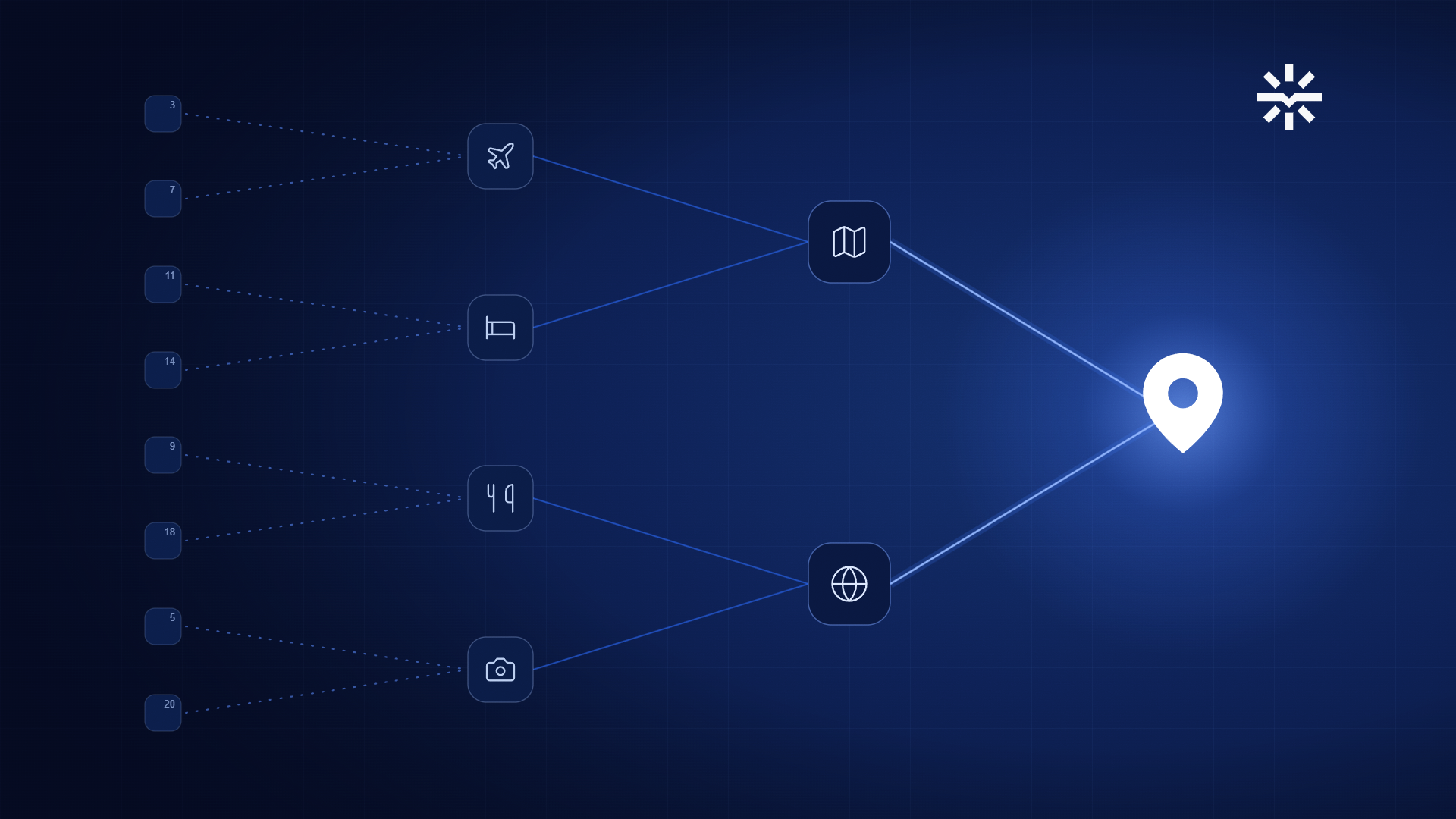
Voyagier Blueprint is the engine behind every trip planned on Voyagier. My co-founder, Mark Davis, and I designed it as a Twenty Questions engine for travel. It's built for imperfect answers and guided by the idea that the right question, asked at the right moment, is more valuable than a thousand unfocused ones.
We think of Voyagier Blueprint as a travel control plane: a system that understands a trip's decisions, constraints, and open questions. Rather than treating the conversation as the source of truth, Blueprint treats the trip itself as the source of truth.
Voyagier Blueprint is built on three core principles.
Voyagier Blueprint always knows what has been decided. Every flight, hotel, activity, transfer, and traveler preference exists as a structured open question. Blueprint knows what is confirmed, what remains open, and how one decision affects another. There is no need to reread a conversation thread to understand where planning stands. The plan is the state.
Voyagier Blueprint always knows what can be inferred. When a family of four tells us they want Cape Town in October, Blueprint already understands a great deal without asking. It knows the airport, that October is spring in the Southern Hemisphere, that four people likely means a family room configuration, and that the activities worth surfacing are the ones that work for kids. Good advisors don't ask what they can already work out. Neither should AI.
Voyagier Blueprint always knows what to ask next. Not every question has equal value. Blueprint continuously identifies the question most likely to move planning forward by reducing uncertainty and narrowing options. Sometimes that's flexibility on dates; sometimes it's budget; sometimes it's understanding which experience matters most. The goal isn't to ask more questions. It's to ask the right one.
VIA: AI powered by Blueprint
Sitting on top of Voyagier Blueprint is VIA, the Voyagier Intelligent Agent. VIA handles the conversation, accesses live inventory, surfaces recommendations, and helps travelers and advisors make decisions. But Blueprint provides the structure underneath. That's an important distinction.
The conversation feels natural because AI is good at language. The plan stays coherent because Blueprint is managing the logic, state, constraints, and decision-making behind the scenes. Advisors can view and influence that structure at any time. Their expertise isn't replaced by AI, it's amplified by it.
Why this matters
After a year of operating a real travel business, we've come to a simple conclusion: the travel industry has spent decades building better ways to answer questions. The next generation of travel technology will be built around understanding which questions to ask.
Today, Blueprint runs live across the trip: flights, hotels, and activities, with dining next. Whether a traveler comes to it directly, through an advisor, or through an AI agent acting on their behalf, the engine underneath is the same. The industry spent decades getting good at answering questions. The next decade belongs to whoever gets good at asking them.
In Twenty Questions, the winner isn't the person who asks the most questions. It's the person who asks the right ones.
That's the company we've built.
Daniel Gardner CEO, Voyagier